
25 Sep 2026
European match officials complete L2 accreditation
- In 2025 IRL launched the most expansive investment into grassroots game development in its history.
- The technical education project objective is to ensure that every IRL member nation is able to produce its own coaches and match officials, through accredited local educators, and its own educators, through accredited local tutors, ensuring self-sufficiency, local leadership development and greater global capacity.
- The IRL's system focuses heavily on continuing technical development between courses, to ensure that acquired knowledge turns into maturing understanding of the game, higher technical standards and an authentically developed sport.
- The project is underpinned by state of the art e-learning management systems and coaching resources
Match officials from four European nations are celebrating achieving IRL Level 2 Match Officials accreditation after recently completing their Level 2 CATO+ assignments.
CATO stands for Consolidation-Application-Team/training-Observation and is the post-course work that IRL technical education candidates undertake after attending an in-person course, turning their certification into accreditation. CATO+ is linked to the Level 2 course.
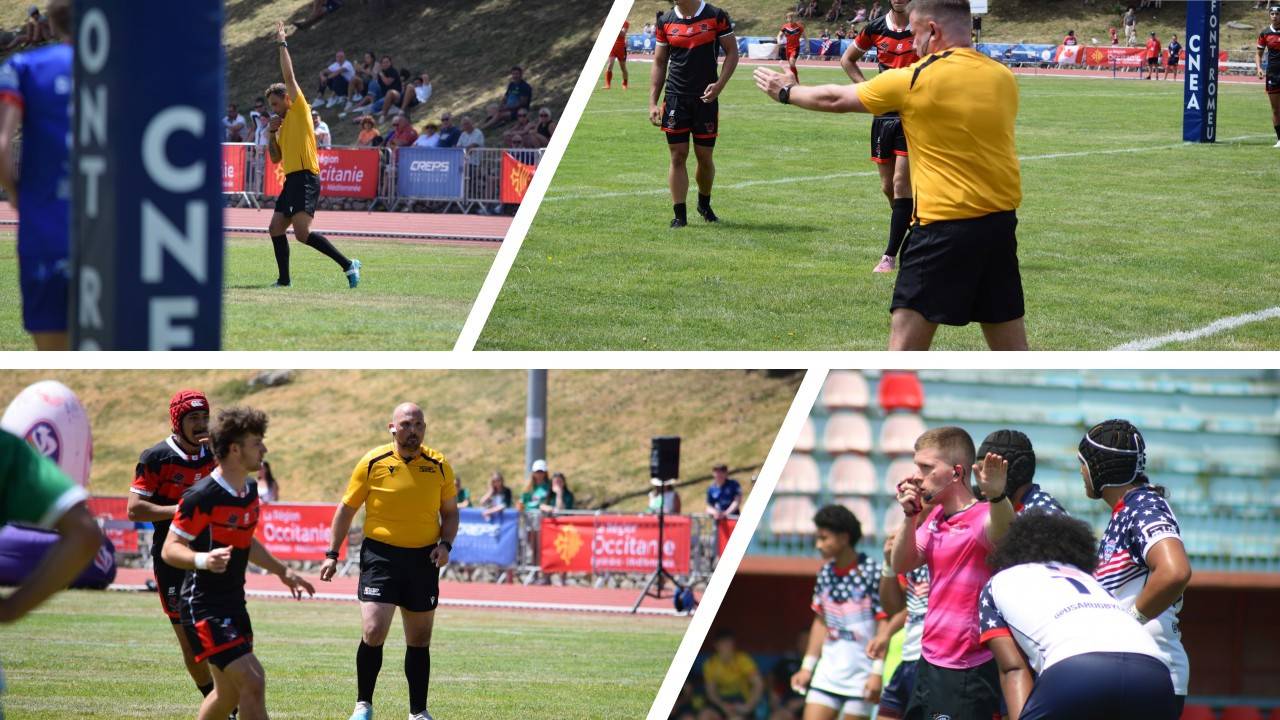
Nectarios Tsakalos (Greece), Joseph Rago (Norway), Petar Randjelović (Serbia) and Craig Davies (Wales) all undertook the IRL Level 2 Match Official course while in attendance at the European Rugby League U19s Championships in July and under the guidance of IRL Match Official Tutor Steve Hogan have now completed all of the CATO+ work online on the IRL Technical Education Portal.
“The Level 2 course has been a big step up for me,” commented Randjelović. “The sessions were practical and clear, and the CATO+ work in particular changed the way I look at my own refereeing. Going through the match video and logging every decision made me honest with myself about what I was actually doing on the field, not just what I thought I was doing.
“The biggest improvement has been in my match preparation and my decision-making under pressure. I now go into every game with two or three specific things to work on, and I review afterwards to see if I achieved them. My positioning, my speed to the try line and my communication with captains and touch judges have all improved because I can see exactly where I am losing time or credibility. It has given me a proper structure to develop rather than just refereeing game after game and hoping to get better.”
Randjelović’s next assignment will be to take charge of Netherlands v Ukraine in the recently announced Euro B Championship which will take place in Belgrade next month, a deserved appointment for his commitment to securing IRL’s highest Match Officials qualification and he has had further international action this summer taking charge of Montenegro v Serbia U19M.
Tsakalos will take charge of the Euro C encounter between Greece and Germany, whilst Davies will be involved in some of Wales’s Autumn internationals, with full details to be finalised.
“I really enjoyed the courses and it was awesome getting into the finer details of the sport I love,” added Davies. “They’ve really boosted my confidence and given me a better feel for refereeing rugby league. The game management section was definitely the most useful part, knowing the laws is essential, but actually managing the game is what makes a great referee.”
All four officials will shortly start their training to become Level 1 Educators, giving them and their respective National Federations the capacity to deliver IRL’s entry level match officials course and to be able to support its candidates through the CATO programme. Their next progression will be to become Level 1 Tutors, with the ability to train and qualify Level 1 Educators.
“I’m very pleased to be able to have signed off the first batch of graduates from the European Match Officials Booster event in France,” explained Hogan, one if IRL’s most experience Tutors. “Having the squad in camp for a full week gave them a great opportunity to gain experience on field as part of the tournament, but they were all able to use their time off the field to develop their understanding and undertake the Level 2 course. They have applied themselves afterwards to complete CATO+ and to help them progress on the field and I am looking forward to seeing how they perform in the upcoming internationals.”